

The rise of People’s Republic of China has been one of the astonishing narratives of the 21st century. The story began with Den Xiaoping in the year 1979. Its economic miracle, military modernization, and growing global influence have led many to label it a superpower. It’s a nation poised to challenge, if not surpass, the United States on the world stage. However, a closer examination reveals a more complex picture, suggesting that while China is undoubtedly a major global power, the superpower label might be premature, and its strength potentially overestimated in some key areas. Let us take a look at the closer picture if China is a superpower or an overestimated force.
An Established Economic Superpower
There was a time when China’s GDP trailed just a few billion dollars behind India’s. Today, it stands at a humongous $19 trillion—dwarfing India’s $4 trillion by nearly five times. China’s economic growth over the past few decades has been nothing short of astonishing. With an average annual growth rate exceeding 10%—and at times reaching 15%—four decades of rapid economic development lifted 800 million people out of poverty. It has become the world’s second-largest economy, a manufacturing powerhouse, and a key driver of global trade. The country has largest Foreign Exchange Reserves in the world at $3.6T, which is three times that of second-placed Japan at $1.2T. This is the result of a persistent trade surplus driven by massive exports and a strong manufacturing base.
Rising Military Superpower
The People’s Republic of China has the largest army, largest navy by number of warships. It’s the largest air force by number of fighter fleet in the world, second only to the US. The rapid military modernization has made PLAAF second country after the United States to successfully deploy a large fleet of 5th gen fighter jet. It operates more than 300 5th Gen Chengdu J-20 jets. It also has a large fleet of 4th jets such as J-16, J-11 and Su-30s and decent fleet size of 4.5 gen fighters such as Su-35, and Xian H-6 and JH-7 bombers. Recent reports suggest that it is aggressively testing the 6th gen fighters such as J-36 and J-50.
People’s Liberation Army Navy (PLAN)
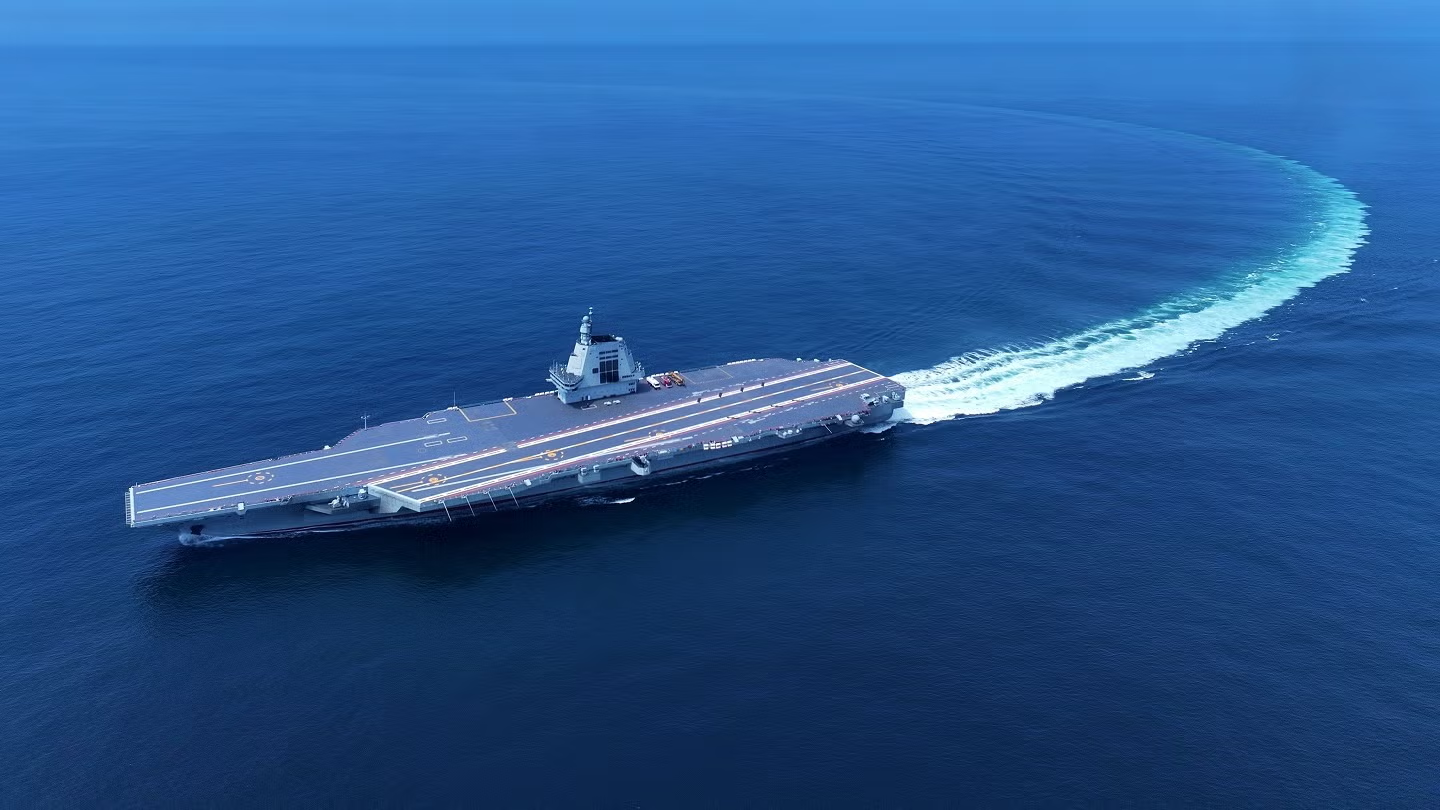
Already the largest navy in the world, PLAN has wide range of warships. The PLAN’s growth is remarkable, with three aircraft carriers, including the next-gen behemoth Fujian. Its CATOBAR system with EMALs technology places it in an elite category alongside the U.S. Gerald Ford-class carriers. The fleet of over 70 submarines, including 16 nuclear subs (9 SSNs and 7 SSBNs), underscores their focus on maritime dominance. These naval assets allow Beijing to project its power far beyond its immediate maritime borders.
The Chinese shipbuilding industry has become so dominant that it outpaces the US by 232 times. Although the United States still leads, the technological gap is rapidly decreasing between the two navies. Reports suggest that China’s shipbuilding output is staggering, producing over 1,700 vessels annually compared to the U.S., which constructs only a fraction of that. This dominance allows China to rapidly expand its naval capabilities, including its fleet of advanced warships and submarines. Additionally, China’s focus on nuclear-powered submarines, aircraft carriers and other cutting-edge naval assets underscores its ambition to challenge traditional maritime powers. These powerful cutting-edge warships allow it to project power second only to the US Navy.
People’s Liberation Army Airforce (PLAAF)

The PLAAF has undergone remarkable modernization, transforming into one of the most advanced air forces globally. Apart from having the next gen stealth fighters, it also has wide range of 4 and 4.5 gen fighters. These fighters allow Beijing to operate with high flexibility and precision across different missions for air superiority, ground attacks and multirole operations. These aircraft extend China’s operational reach and bolster its defense strategy, enabling it to protect national interests, assert its presence in contested regions like the Taiwan Strait and South China Sea, and even support potential overseas operations.
The PLAAF is increasingly engaging in joint drills with other nations, expanding its operational experience and influence. The PLAAF aims to achieve air dominance as a prerequisite for supremacy with the advancements in long range air-to-air, air-to-surface and hypersonic missiles.
Emerging Technologies
China is making remarkable strides in emerging technologies, aiming to establish itself as a global leader. From robotics and automation to quantum computing, AI, space exploration, aerospace, and green energy, the country is rapidly cementing its position on the global stage. China is leading in quantum communication (satellite included), ensuring secure data transmission for military and financial applications. In AI, it is integrating machine learning into autonomous systems, including drones and decision-making platforms, to bolster its technological edge. Some reports suggest that China has already surpassed Russia in hypersonic technology. From deployment of hypersonic missiles capable of reaching Mach 16 to active testing of hypersonic flights, it is leading the world.
Space Superpower

China is the only country that has its own Space Station in the Orbit. The Tiangong space station, fully operational since 2022, is a testament to China’s independent capabilities. It has completed all the lunar missions with 100% success including landing a lander, rover and collecting samples and bringing back to earth. The country aims to land humans on Moon by 2030. It has plans for an International Research Station on Moon in collaboration with Russia by 2035. Having successfully landed a rover on the Martian surface; it aims to bring Martian soil on earth with Tianwen-2 mission. Such missions have already made CNSA the close the technological gap with NASA, making it a leader in Space domain.
Energy Powerhouse
China has firmly established itself as an energy powerhouse, leveraging its vast resources and technological advancements to lead in renewable energy sectors. It is the largest producer of solar panels and has installed massive solar parks, contributing significantly to global solar capacity. China is a leader in energy storage technologies and the electrification of transport. It already produces 60% of the world’s EV batteries and has a robust infrastructure for electric vehicles. Its homegrown company BYD has become a well-established brand as well as competing with Tesla in global arena.
Is China a Superpower of an Overestimated Force?
The statistics and dynamics suggest that the People’s Republic of China is already a Great Power. Its advancements in hypersonic technology, AI, quantum computing, and green energy are reshaping industries and global security dynamics. However, being a superpower extends beyond raw metrics and innovation—it involves complex geopolitical influence, sustained economic resilience, and the ability to navigate international challenges seamlessly.
While China excels in many domains, challenges like economic imbalances, diplomatic friction with the West and the US in particular persists. For now, the People’s Republic of China stands as a rising Great Power—impressive, yet not invulnerable—making it both a force to be reckoned with and one that continues to evolve.
In my opinion, China is a superpower not an overestimated force. It is a force that demands respect, a force to reckon with. And it is only a matter of time when the world will accept this.


Leave a Reply