
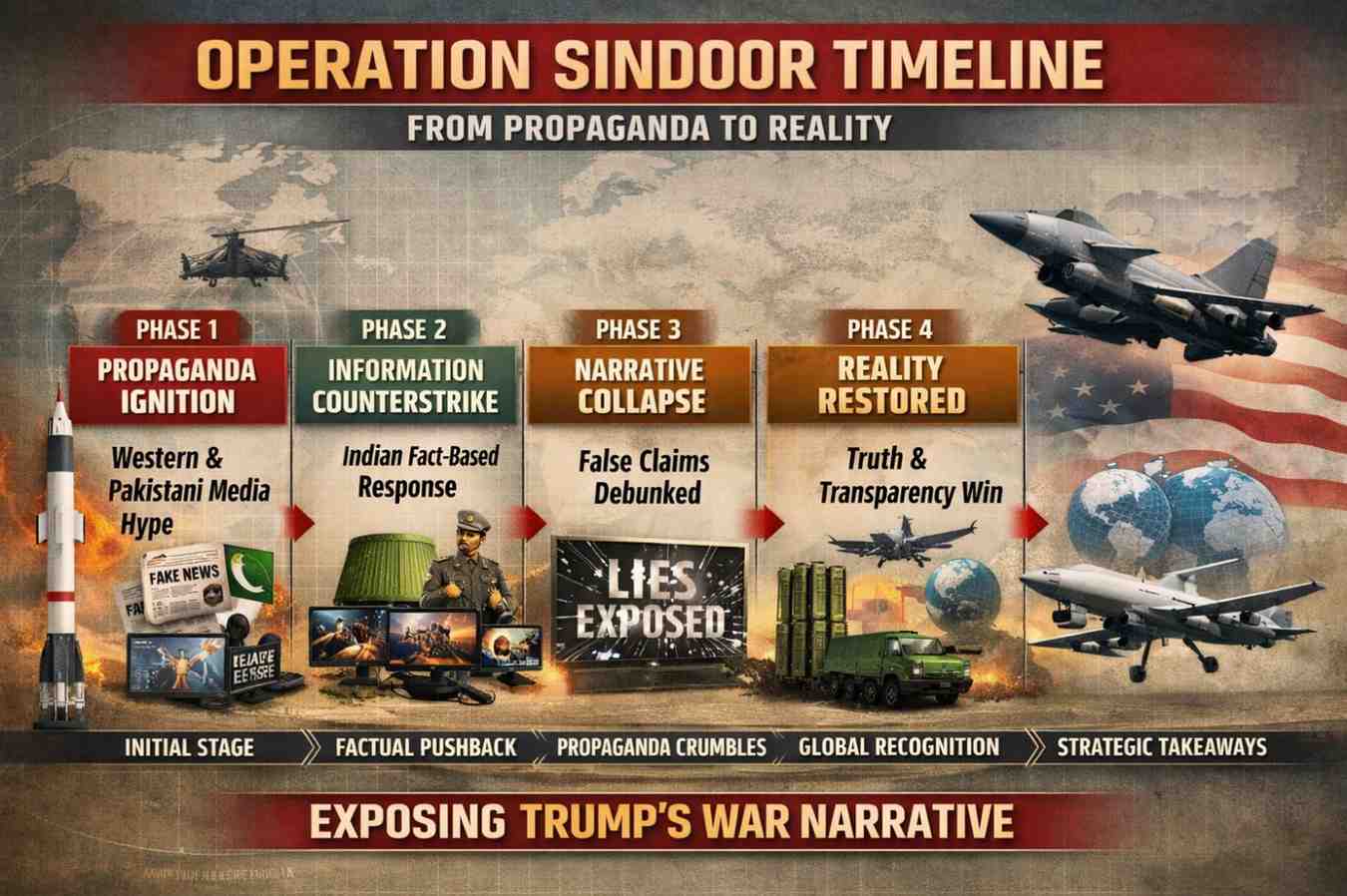
In war’s fog, truth is the first casualty, especially in India’s Operation Sindoor narratives. Operation Sindoor became more than a military campaign; it was a propaganda clash where reality confronted distortion. Pakistani claims of downed Rafales and Sukhois were dismantled when the IAF released its 36‑jet maintenance contract. The IAF Chief’s remark turned falsehood into leverage, letting misinformation collapse under its own weight. Chinese defense systems and Turkish drones were glorified far beyond reality, while Trump’s “war‑stopping” rhetoric added distortion. The Operation Sindoor Propaganda War exposed CPT (China Pakistan Turkey) lies

Operation Sindoor Propaganda War: Context and Controversy
Operation Sindoor unfolded against a backdrop of escalating tensions and shifting power balances in South Asia. For India, the operation was not just about neutralizing immediate threats and avenging those brutally murdered based on their religion. “It signaled deterrence while dismantling Pakistan’s propaganda, amplified by Chinese narratives. Pakistan’s Rafale and Sukhoi claims collapsed when the IAF’s 36‑jet maintenance contract exposed their hollowness.
The IAF Chief’s remark — that if Pakistan believes it has destroyed five or ten jets, “let them keep believing it” — turned falsehood into strategic advantage, ensuring adversaries underestimated India’s true strength. Chinese systems and Turkish drones were glorified, while Trump’s ‘war‑stopping’ rhetoric added distortion. Operation Sindoor proved that controlling narratives is as decisive as missiles and aircraft: propaganda may win headlines, but facts and readiness win wars.
Operation Sindoor Propaganda War: Pakistani Claims of Downed Rafales

In the aftermath of Operation Sindoor, Pakistan’s propaganda machine went into overdrive, claiming that multiple IAF Rafales and Sukhois had been shot down. These exaggerated numbers were never backed by evidence, yet they served a clear purpose: to project a false sense of victory to domestic audiences and to sow doubt internationally about India’s air superiority.
The Indian Air Force countered these claims decisively. By releasing the maintenance tender covering all 36 Rafales, the IAF demonstrated that every jet remained operational and combat‑ready. This factual disclosure dismantled the illusion of losses and exposed the hollowness of Pakistan’s narrative.
Adding weight to this rebuttal was the IAF Chief’s sharp remark: if Pakistan believes it has downed five or ten jets, “let them keep believing it.” This statement turned propaganda into a liability, ensuring that Pakistan would underestimate India’s actual strength in future encounters. What was intended as psychological warfare instead became a strategic advantage for India.
IAF Rafale Tender Exposes Propaganda

One of the most decisive blows to Pakistani propaganda came not from missiles or dogfights, but from paperwork — the Indian Air Force’s release of the maintenance tender covering all 36 Rafales. This contract confirmed that every Rafale in India’s fleet was fully operational, combat‑ready, and under guaranteed support, leaving no room for speculation about “downed” jets.
By making this information public, the IAF not only dismantled exaggerated claims but also showcased its commitment to transparency and readiness. The Rafale fleet, backed by French technical support and indigenous integration, became a symbol of reliability. In effect, the maintenance contract itself became a strategic weapon — proof that India’s frontline fighters were intact, capable, and prepared for future engagements.
This move turned propaganda into a liability for Pakistan: every false claim of destroyed jets was contradicted by hard evidence of operational strength. It also reinforced India’s narrative that Rafales are not just advanced aircraft, but part of a sustained, well‑maintained combat system designed to dominate the skies.
IAF Chief’s Statement: Turning Lies into Strategic Advantage

“These are their “Manohar Kahaniyan”. Let them tell these stories to their public to save their face.” – IAF Chief Amar Preet Singh
In one of the most striking remarks of the conflict, the IAF Chief stated that if Pakistan believes it has downed five or ten Rafales or Sukhois, “let them keep believing it.” This was not just a dismissal of propaganda — it was a calculated psychological move. By allowing the adversary to cling to false victories, India ensured that Pakistan would underestimate its actual strength the next time conflict arose.
How Falsehoods Weaken the Adversary?
Propaganda thrives on illusion, but illusions can be dangerous for those who believe them. Pakistan’s inflated claims created a false sense of achievement, which risks complacency and miscalculation in future encounters. When an adversary assumes India has fewer jets than it truly does, their planning and strategy are built on sand. This transforms propaganda from a weapon into a weakness — a liability that India can exploit. “The IAF Chief’s statement turned lies into leverage, letting misinformation collapse under its own weight.
Chinese Defense Systems in the Sindoor Propaganda War

Propaganda Around Chinese Tech
Pakistan leaned heavily on its partnership with China during Operation Sindoor, showcasing systems like the J‑10C fighters, HQ‑9 air defense batteries as proof of technological superiority. Chinese media amplified these claims, portraying their equipment as “game‑changers” that could neutralize India’s Rafales and Sukhois. The narrative was clear: Chinese defense technology had tilted the balance in Pakistan’s favor.
Battlefield Limitations
Reality told a different story. Despite Beijing’s direct support — including engineers stationed at Pakistani airbases — these systems failed to deliver decisive results. The HQ‑9 batteries could not prevent precision strikes on airbases, JF-17s and F-16s were downed despite advanced missiles. The gap between propaganda and performance was stark: advanced hardware alone did not guarantee battlefield success. India’s air superiority exposed Chinese system limits, undermining the invincibility narrative.
Turkish Drones: Hype vs Reality
Media Glorification
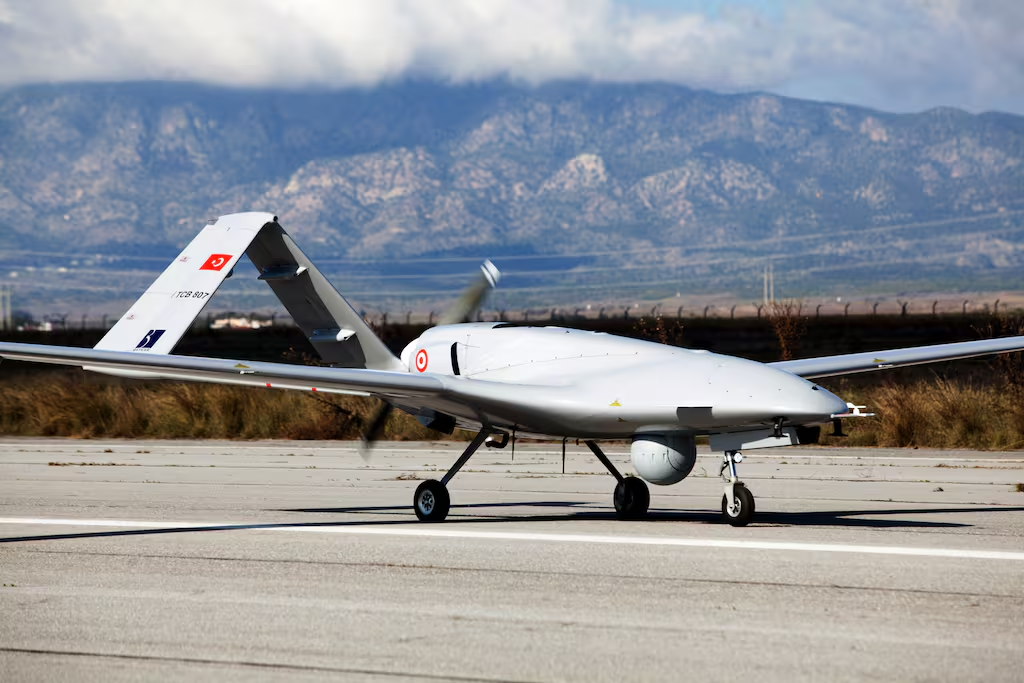
During Operation Sindoor, Turkish drones such as the Bayraktar TB2 were heavily glorified in media narratives. Pakistani outlets glorified drones as decisive, echoing Libya and Nagorno‑Karabakh successes. Drone swarms, precision strikes, and dominance were emphasized, portraying Turkish technology as a battlefield game‑changer.
Actual Combat Outcomes
Reality, however, was far less dramatic. Against India’s layered air defense network — including Akash and Akashteer — Turkish drones struggled to achieve meaningful impact. Many were intercepted before reaching targets, while others failed to penetrate radar coverage. Their limited payloads and vulnerability to electronic warfare exposed the gap between hype and performance. Instead of altering the course of the operation, Turkish drones became symbolic of how propaganda can inflate battlefield tools beyond their actual utility.
Operation Sindoor Propaganda War Exposed Trump’s War Narrative

Contradictions in U.S. Policy
Operation Sindoor also exposed the contradictions in American foreign policy. On one hand, Washington continues to preach about a “rules‑based order” and condemn others for violating international norms. On the other, its own military actions — from targeting civilian vessels to selectively backing allies — reveal a double standard. This hypocrisy undermines U.S. credibility and fuels resentment among nations that see America as clinging to its historical power in trade, technology, and military influence rather than demonstrating modern strategic strength. The narrative of moral authority collapses when actions contradict rhetoric.
Trump’s Claims of “Stopping the War”
Adding to the distortion was Donald Trump’s bold assertion that he had “stopped the war.” In reality, Operation Sindoor unfolded with intensity, and Trump’s claim functioned more as political theater than strategic fact. His statement was aimed at projecting control and leadership, but it ignored the realities on the ground — where propaganda, drone warfare, and defense systems were actively shaping outcomes. For India, this highlighted how external narratives often serve domestic political agendas rather than reflecting battlefield truth. Trump’s words became part of the larger propaganda ecosystem, reinforcing the theme that perception, not reality, was being weaponized.
Strategic Lessons from Operation Sindoor Propaganda War: Propaganda Downed, Reality Restored

Operation Sindoor showed that propaganda can dominate headlines but collapses against verifiable evidence. Pakistan’s claims of downed Rafales and Sukhois were disproven by the maintenance contract for all 36 Rafales, while Chinese and Turkish systems failed to match their hype. Facts, not inflated stories, defined the outcome.
By letting adversaries believe their own falsehoods, as the IAF Chief noted, India turned misinformation into a weakness for its opponents. Coupled with indigenous systems like BrahMos, Akash, and Akashteer, India demonstrated that strength lies in both capability and narrative control. Operation Sindoor proved that in modern conflict, dismantling illusions is as vital as battlefield victories.
Conclusion:
Operation Sindoor wasn’t just about jets, missiles, or defense systems — it was about who could shout the loudest and still get believed. Pakistan claimed it had downed Rafales like they were falling out of the sky on sale, China paraded its “invincible” tech like a showroom launch, and Turkey’s drones were hyped as if they were Marvel superheroes. And then, of course, America chimed in with its usual contradictions, while Trump proudly declared he had “stopped the war” — apparently by sheer force of imagination.
Yet when the dust settled, the scoreboard didn’t favor the loudest voices but the most prepared ones. India’s Rafales remained intact, BrahMos struck with precision, Akash and Akashteer shielded the skies, and the IAF Chief coolly reminded everyone: “let them keep believing.” In other words, India didn’t just win the battle — it let its opponents drown in their own delusions.
The lesson? In modern conflict, propaganda may win hashtags, but facts win wars. Operation Sindoor proved that India’s edge lies not only in firepower but in the ability to turn enemy lies into strategic leverage. Reality restored, illusions shattered — and the loudest voices left echoing in their own empty chambers.
- Global Energy Criss: click here to read
- US Stock Market Crash: click here to read
- How China is defeating US in different domains: click here to read
Operation Sindoor: IAF Shoots Down Pakistani F-16, JF-17 Jets in May 2025


Leave a Reply