

The outbreak of Israel US war with Iran in early 2026 marks a turning point in Middle Eastern geopolitics. With the death of Iran’s Supreme Leader Ayatollah Ali Khamenei in targeted strikes, escalating missile barrages, and drone warfare across the Persian Gulf, the conflict has reshaped global power dynamics and triggered ripple effects across energy markets, regional alliances, and international diplomacy.
Israel US war with Iran is reshaping Middle Eastern geopolitics, with nuclear security, maritime chokepoints like the Strait of Hormuz, and great-power involvement such as Russia, China & EU at the center of the conflict. The struggle is not only military but also diplomatic, economic, and narrative-driven, with global energy markets and regional alliances under severe strain.

Regional & Global Actors:
- United States: Seeks to protect forces, maintain freedom of navigation, and avoid prolonged war. Domestic political risk is high.
- Israel: Focused on degrading Iran’s missile/drone capacity and sustaining deterrence, but faces legitimacy challenges internationally.
- Iran: Prioritizes regime survival, deterrence credibility, and imposing economic/political costs on adversaries.
- Gulf states: Qatar, UAE, and Oman fear becoming battlegrounds; they emphasize maritime security and infrastructure protection.
- Russia & China: Both exploit the crisis to expand influence, offering uranium relocation proposals (Russia) and diplomatic backing (China).
- Europe: EU states criticize Israel’s Gaza actions and push for sanctions, while also seeking maritime security frameworks.
Strategic Objectives:
- For Israel:
- Neutralize Iran’s nuclear infrastructure so that it does not produce nuclear weapons to attack Israel in the future.
- Degrade the Iran’s Islamic Revolutionary Guards Corps capabilities by targeting the command centers, missile bases and drone factories.
- Prevent Iran from building large scale military industrial complex and drone ecosystem that could overwhelm its defense network in the future.
- For United States:
- Protection of Israel from the missile barrage and drone campaigns. This includes deploying advanced jets like F-22 raptor, MQ-9 Predator drones, missile systems, intelligence sharing and rapid military support.
- Safeguard the Gulf allies such as Saudi Arabia, Qatar, UAE whose energy infrastructure is most vulnerable to the Iran’s retaliation in the form of drone strikes.
- Maintain the freedom of navigation and keep the Strait of Hormuz open to safeguard global energy flow and prevent Iran from weaponizing energy and Hormuz.
- Send a message to the adversaries like Russia and China that US remains committed to protect its allies despite the political division back home
- For Iran:
- To maintain the sovereignty and protection of its facilities.
- To ensure that the IRGC regime survives and function as smoothly as possible without much resistance at home.
- Preserve the military and military equipment so as to retaliate when and where needed on Israel and Gulf countries.
- Leverage and expand the asymmetric tools such as drones, missiles, cyber warfare, energy disruption and most importantly the control over Strait of Hormuz.

Israel US war with Iran: Oil Shock & impact on the Global Economy
The Energy fallout of the Israel US war with Iran has not only destabilized the Middle East but also unleashed a profound oil shock that reverberates across the global economy. With crude prices surging, LNG markets tightening, and shipping routes through the Strait of Hormuz under constant threat, nations worldwide are grappling with inflationary pressures, currency volatility, and energy insecurity. The impact is uneven — Asia, Europe, and the United States each face distinct vulnerabilities shaped by their energy dependencies and geopolitical positions.
Israel US war with Iran: Impact on Asia
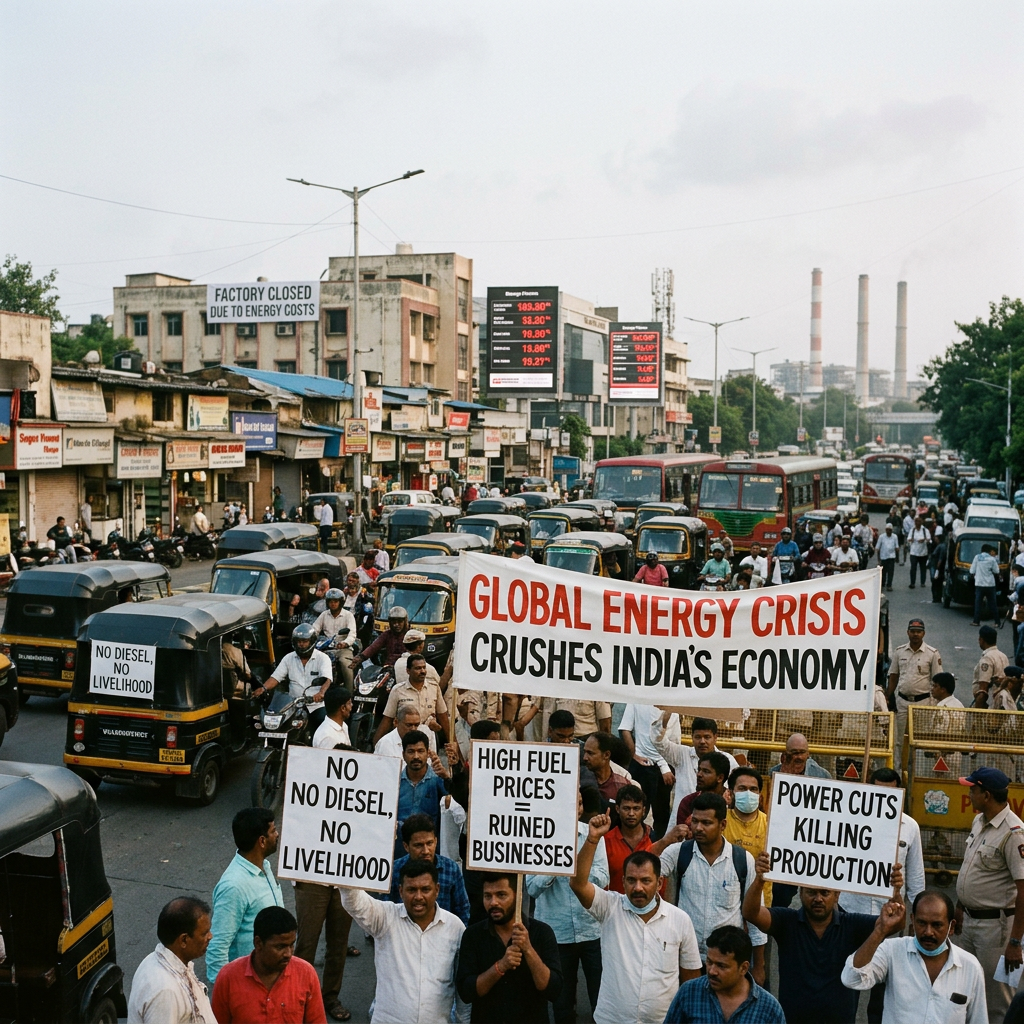
Asia, being the world’s largest importer of energy, absorbed the full blunt force of the sudden surge in prices. LNG spot prices have more than doubled compared to the previous year, straining economies from Japan to India. This has also exposed India’s vulnerability and China’s positioning of strength. Petrol and diesel costs surged between 15–35%, depending on the country, eroding household budgets and raising transport costs across the region.

- India’s vulnerability: Import bills have been on the rise ever since and has crossed $16B in the month of April. This is a 50% surge compared to the April 2025. Indian Rupee has depreciated 8-9%, amplifying the cost of dollar dominated imports. Consumer inflation has climbed above 7.5% with food prices leading the surge. Petrol and diesel have crossed ₹110 and ₹95 in most of the major cities which is an increase of around 8%, one that has rippled across transport, logistics and agriculture. Rising energy costs have triggered major disruptions in manufacturing, fertilizers and food supply chains.
- China’s strength positioning in renewables: China has leveraged the 2026 energy crisis to secure discounted crude from Iran and Russia, therefore positioning itself as a stabilizer while quietly expanding influence. At the same time, Beijing’s vast and diversified investment in renewable energy has begun to pay dividends, which has helped it navigate the global energy crisis more effectively. The massive 1.4 billion barrels, which accounts for half of the global strategic reserves has allowed its industries to stay afloat even in the ongoing crisis. By presenting itself as a reliable energy partner, China deepened ties with Gulf states and positioned itself as a counterweight to Western pressure. It framed its renewable success as proof of long‑term planning, using the crisis to project leadership in global energy transition debates.
Israel US war with Iran: Impact on Europe
Prior to the world facing the current energy crisis, it was Europe that first felt the shockwaves when Russia’s conflict with Ukraine erupted in February 2022. The war pivoted the EU away from the cheap Russian oil & gas, triggering a painful economic transition towards expensive LNG, oil and gas imports. But the Global Oil Crisis of 2026 brought an even further disaster for the Europeans because it compounded those vulnerabilities, creating a second, sharper energy shock.
- LNG scramble: With Gulf supplies disrupted, Europe rushed to secure contracts from Norway, United States and North Africa and to some extent, Russia, and driving up spot prices.
- Inflationary strain: Fuel and fertilizer costs surged again, feeding directly into food inflation. Households across Germany, France, and Italy faced steep energy bills, reviving fears of stagflation.
- Policy response: EU states criticized Israel’s Gaza actions, pushed sanctions on Iran, and sought maritime security frameworks to protect Mediterranean and Red Sea routes.
- Strategic vulnerability: Europe’s dependence on external LNG suppliers highlighted its fragile energy autonomy, forcing accelerated investment in renewables, nuclear power, and energy storage.

United States: Domestic Strain & Alliance Credibility
The oil shock of 2026 hit the United States at the very heart of its economy and politics. The gasoline price surged rapidly with political division and global commitments because of the oil shock 2026.
- Domestic backlash: Gasoline prices surged nationwide, fueling public anger and intensifying partisan debates over foreign entanglements. Inflationary pressures revived fears of stagflation, echoing the 1970s oil crises.
- Alliance credibility: Washington faced the dual challenge of protecting Israel from missile and drone saturation while reassuring Gulf allies that their energy infrastructure would not collapse under Iranian retaliation.
- NATO response: Defense spending across NATO rose to 2.5% of GDP, signaling renewed commitment but straining budgets already pressured by inflation.
- Economic ripple effects: Rising logistics and manufacturing costs hit American industries, from aviation to agriculture, while consumer confidence dipped sharply.
- Strategic balancing: The U.S. had to weigh the costs of prolonged engagement against the risks of withdrawal. A drawn‑out war threatened to drain resources, weaken domestic support, and embolden rivals like Russia and China.
Global Inflation & Trade
The oil shock of 2026 reverberated far beyond the energy sector, shaking the foundations of the global economy. Almost overnight, rising crude prices cascaded into higher costs across industries, while disrupted shipping routes magnified the strain on trade flows. What began as an energy crisis quickly evolved into a worldwide inflationary spiral, testing the resilience of both advanced economies and vulnerable emerging markets. In this environment, every link in the supply chain—from tankers to fertilizers—became a pressure point, driving up costs and fueling instability.
The oil shock did not limit itself to the energy markets – it exploded into a worldwide inflationary spiral and distributed global trade flows.
- Crude price surge: Double‑digit increases in oil prices raised costs across industries, from petrochemicals to fertilizers, directly impacting food production and manufacturing.
- War‑risk premiums: Insurance costs for tankers navigating the Gulf skyrocketed, adding billions to shipping expenses and forcing companies to pass costs onto consumers.
- Supply chain stress: Delays through the Strait of Hormuz disrupted global trade flows, raising costs for food, consumer goods, and industrial inputs.
- Emerging markets hit hardest: Countries with high energy import dependence — India, Pakistan, Bangladesh — faced currency depreciation and inflationary spirals, amplifying social and political instability.
- Food inflation: Rising fertilizer and transport costs pushed global food prices upward, sparking protests in several developing nations.
- Industrial slowdown: Manufacturing hubs in Asia and Europe reported reduced output as energy costs eroded competitiveness.

Israel US war with Iran – Conclusion
The Israel US war with Iran will define new global power dynamics. The oil shock of 2026 has fractured the global economy along geopolitical lines. Asia absorbed the blunt force of price surges, exposing India’s vulnerabilities while allowing China to consolidate influence through discounted crude and renewable investments. Europe, already weakened by its pivot away from Russian gas, faced a second, sharper shock that revived fears of stagflation and underscored its fragile energy autonomy. In the United States, rising gasoline prices collided with political divisions, testing Washington’s ability to sustain alliances while managing domestic backlash. Meanwhile, global trade and inflationary spirals hit emerging markets hardest, amplifying instability across South Asia, Africa, and Latin America.
Together, these dynamics reveal how the oil shock is not just an economic crisis but a geopolitical weapon — fragmenting responses, deepening the divide between Western powers and Russia/China, and accelerating the shift toward a multipolar world order where energy security defines strategic leverage.
The war is less about battlefield victory and more about controlling escalation, shaping global narratives, and securing long-term strategic leverage. Durable peace would require verifiable nuclear disarmament, maritime security guarantees, sanctions relief, and multilateral sovereignty assurances—a framework far beyond military coercion.
Key Takeaways
- Asia’s vulnerability: LNG prices doubled, petrol/diesel rose 15–35%, with India facing a $16B import bill surge and currency depreciation.
- China’s positioning: Secured discounted crude from Iran/Russia and leveraged renewable investments to stabilize its energy outlook.
- Europe’s compounded crisis: Already weakened by the Ukraine war, Europe scrambled for LNG, faced inflationary strain, and accelerated renewable/nuclear investments.
- U.S. domestic strain: Rising gasoline prices fueled political divisions, while Washington balanced protecting Israel, Gulf allies, and freedom of navigation.
- Global trade disruption: War‑risk premiums, shipping delays, and fertilizer costs drove inflation worldwide, hitting emerging markets hardest.
China vs US: Dominance Across Every Frontier: click here to read
Global Energy Crisis: click here to read
US vs China: Rivalry in 2026: click here to read

Leave a Reply