
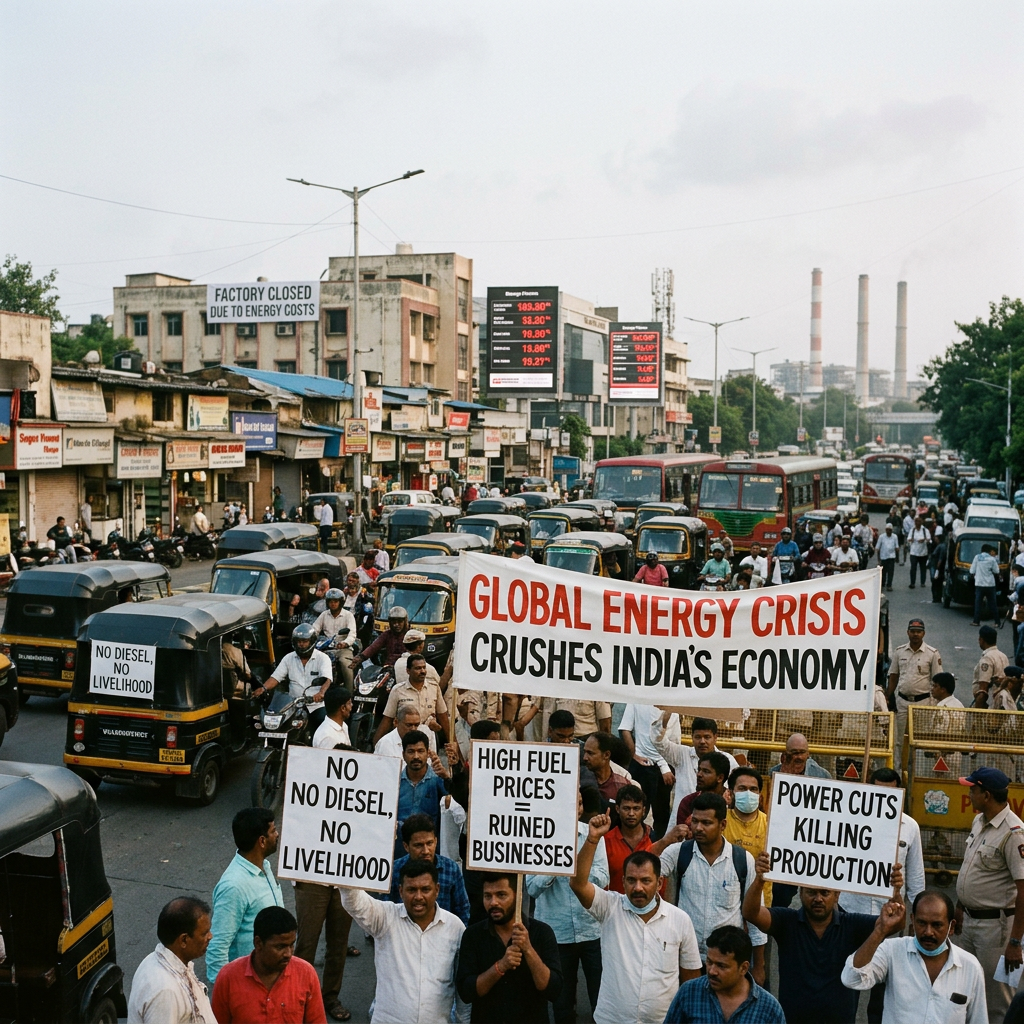
The Energy Wars 2026 has escalated into a struggle over energy lifelines and maritime choke points, driving what many now call the global energy crisis 2026. Blockade diplomacy in the Strait of Hormuz, Iran’s expanding drone campaigns, and surging oil prices are colliding with shifting defense alliances to reshape the global order. For India, the consequences are immediate and profound: securing energy supplies, protecting trade routes, and defining its role in Asia’s evolving balance of power.
Energy Wars 2026: Blockade Diplomacy in Hormuz
The Strait of Hormuz, a narrow passage in the Persian Gulf, has become an epicenter of the new global energy crisis in 2026. Every disruption – naval blockade or drone strikes or tanker seizures, leads to soaring global oil prices. Iran’s drone diplomacy, with a weaponized skies above the Gulf, has recalibrated the American gulf strategy.

The Strait of Hormuz carries nearly 20% of global oil flows, making it the single most critical maritime chokepoint in the world. According to the International Energy Agency (IEA), even a 48‑hour disruption can spike oil prices by 15–20%.
Iran’s drone diplomacy — targeting tankers and threatening naval escorts — has forced the U.S. Fifth Fleet to expand patrols, while insurers like Lloyd’s of London have tripled premiums for Gulf shipments. For India, which imports over 85% of its crude oil, this translates into:
- Rising import bills: Crude costs surged by 22% in Q1 2026.
- Currency pressure: The INR has depreciated 8% against the USD in three months.
- Supply chain fragility: LPG shipments face delays, raising household energy costs.
For India and alike countries, the implications are more than severe. Rising tanker insurance costs, delays in the shipments and fuel volatility threatens the economic stability. The Indian Rupee INR is nose-diving and has been so for the past three months. The crisis also exposes India’s foreign dependence on energy sector mainly crude oil and LPG, underscoring the urgency of diversifying the supply chains, investing in strategic reserves and the renewable energy sectors. What was once a regional flashpoint has now become a global chokehold, reshaping the calculus of trade and security of every country relying in Middle Eastern energy.

Energy Wars 2026: Oil as a Weapon
If the world has learned something in the last few months, it is the actual value of oil and gas. Oil and gas are no longer neutral commodities — they have become instruments of power. Middle East conflict has weaponized energy flows, with producers and transit states using supply cuts, price manipulation, and selective routing as bargaining chips. Europe scrambles to secure LNG from alternative suppliers, while Asia absorbs the brunt of volatility. According to the International Energy Agency (IEA), global crude prices have surged by 18% since January 2026, while LNG spot prices in Asia have doubled compared to last year.
For India, the challenge is twofold. First, rising import bills strain the economy, pushing inflation into sensitive sectors like food and fertilizer. Second, the crisis exposes the fragility of India’s energy mix, still heavily dependent on Gulf crude. Diversification — through solar, nuclear, and strategic reserves — is no longer a policy option but a national security imperative.
India’s response must go beyond firefighting. Policy analysts argue for:
- Expanding strategic petroleum reserves (SPR) to cover 150 – 180 days of imports.
- Accelerating renewable capacity — solar and nuclear projects.
- Strengthening naval presence in the Indian Ocean to secure trade routes.

Energy Wars 2026: Defense Alliances Reset
The Middle East war has triggered a reshuffling of global defense alliances. NATO members are raising spending targets, Gulf states are seeking new guarantees, and Asian powers are recalibrating their positions. NATO members have raised defense spending targets to 2.5% of GDP with the possible increase to 5% by 2035. Security is no longer defined by geography alone – energy routes and maritime choke points now dictate alliance priorities.
For India, this presents a strategic dilemma:
- Option 1: Increase US and Indo-Pacific cooperation
- Strengthens deterrence against disruptions in the Indian Ocean.
- Enhances access to advanced naval technology and intelligence sharing.
- Risk: Over‑dependence on U.S. policy, which may shift with domestic politics.
- Option 2: Balance ties with Russia and Iran
- Preserves strategic autonomy and energy access from non‑Western suppliers.
- Maintains leverage in multipolar negotiations.
- Risk: Potential isolation from Western alliances and sanctions exposure.
India’s choices are further complicated by the rise of new technologies:
- Drone warfare: Iran’s drone campaigns have redefined Gulf security. India has begun investing in a domestic drone manufacturing ecosystem, but capability gaps remain.
- Cyber defense: Despite talent, India lags in cyber resilience compared to global powers. Cyber vulnerabilities could undermine both military and economic stability.
- Naval modernization: With 90% of India’s trade by sea, expanding carrier groups and submarine fleets is essential to secure energy lifelines.
The reset also extends to technology and defense industries. Drone warfare, cyber capabilities, and naval modernization are becoming the currency of influence. India’s choices in procurement and partnerships will determine whether it emerges as a stabilizing power or remains vulnerable to external shocks. India has started investing in domestic drone manufacturing ecosystem. Cyber capability is something that still eludes even the best of the talents in India.

Energy Wars 2026: Global Economic Fallout
The energy shock unleashed by the Middle East war is reverberating across the global economy. The UN projects world growth slowing to 2.6% in 2026, with trade expansion collapsing outside AI‑linked sectors. Inflationary pressures are most acute in developing economies, where rising fuel and fertilizer costs feed directly into food prices and household budgets.
For India, the stakes are particularly high:
- Crude import bills: India’s oil import costs have surged by $12 billion in the first half of 2026, straining public finances.
- Indian Rupee: INR has depreciated to 97 per USD which has increased the import bills and inflation.
- Inflation risks: Consumer inflation has climbed above 7.5%, with food and fertilizer prices leading the spike.
- Currency volatility: The INR continues to weaken against the USD, complicating monetary policy and raising borrowing costs.
The stakes are particularly high for the largest populus country in the world. A surge in crude import bills strains public finances, while inflation risks eroding consumer confidence and complicating monetary policy. The ripple effects extend beyond economics: higher living costs can shape electoral debates, push governments toward subsidy programs, and accelerate calls for energy independence.
Globally, the crisis is redrawing the map of economic influence. Nations able to guarantee stable energy supplies — whether through reserves, renewables, or diversified trade routes — gain leverage in negotiations. Those caught in dependency cycles face mounting pressure to align with stronger blocs. In this sense, the economic fallout is not just about numbers; it is about who controls the levers of resilience in a fractured world order.

Conclusion: Crisis as Catalyst
The Middle East war which led to the Global Energy Crisis of 2026 is more than a regional conflict — it’s a stress test for the global system. Energy, defense, and economics are now intertwined in ways unseen since the Cold War. Every drone strike or blockade sends ripples through oil markets, alliances, and household budgets from Tehran to New Delhi.
The challenge is not just to endure the turbulence but to transform it into opportunity. Diversifying energy sources, strengthening maritime security, and deepening strategic partnerships can turn vulnerability into leverage. The crisis exposes fragility, but it also rewards foresight.
As nations scramble to adapt, those that invest in resilience — technological, economic, and diplomatic — will define the next chapter of global power. The question is no longer who controls oil, but who controls stability.
The lesson of Energy Wars 2026 is clear: energy is power. Nations that control supply chains wield influence far beyond the battlefield. For India, the crisis is both a warning and an opportunity — a chance to transform energy dependence into resilience.
Internal Blog links:
US vs China: Rivalry: click here to read
China vs US: Dominance across every frontier: click here to read
Fall of America: click here to read
External Links:
Middle East crisis exposes global energy as UN urges shift to renewables: click here to read
Iran’s drone strategy: click here to read


Leave a Reply