
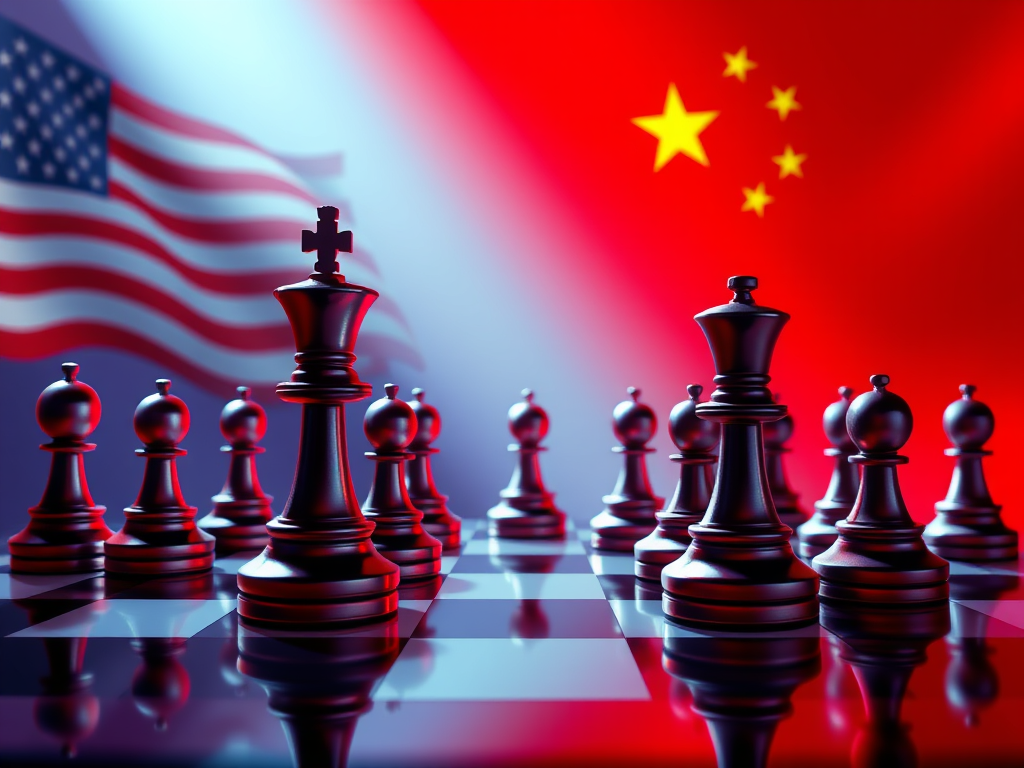
The 20th century was the era of industrialization which was largely dominated by the Western nations. The United States was at the forefront of this industrialization followed by the Soviet Russians and Europeans. The US was the largest contributor to technology, military, trade, economy and global influence amongst many other things. And by doing so, the United States dominated almost every other domain of politics and geopolitics. Now we are in the 21st century. All these factors seem familiar, right? And is it the same player, The United States? Dead Wrong. This time it is the People’s Republic of China, the new superpower, on par with the old superpower. And the US? Just playing catch-up. China vs US: Dominance Across Every Frontier is no longer a projection—it’s the reality shaping global power today.
The 21st century is unfolding more towards a bi-polar with the China challenging US primacy as the King in the grand chessboard. What once seemed like some isolated skirmishes like the tariff war, naval drills around the world, has evolved into a contest between these superpowers that is reshaping the existing rules of globalization itself. The American’s financial primacy, alliance networks and technology is being challenged by China’s Belt & Road diplomacy. The end result is not just a plain simple checkmate but rather relentless struggle for supremacy.

China vs US: Economic Frontier
While the United States of America has the largest economy in the world at $30.5 T, it is followed by People’s Republic of China at $20 T. You would think that this is it, right? US is already ahead of China. But that is not. The full picture tells a different story. The previous was based on the Nominal GDP. But when it comes to the PPP, the story flips. Here China dominates at almost $41 T while US follows with $29 T, and the gap is increasing year on year. China is adding almost $3 T every year whereas US adds around half of that. That’s like adding GDP of South Korea or Mexico every year.
In 2025, Whitehouse imposed 55% tariffs on Chinese imports along with multiple other duty charges. The intent was to slow down the Mighty Dragon’s industrial climb. But unfortunately for the US, things turned out to be way more complicated than the policy makers at the Oval office thought. It was a slap on the face of the American administration when Beijing not only reciprocated the tariffs but also restricted the exports of rare-earth minerals. The Americans thought that this would slow Beijing’s export driven economy, but alas that was not the case. In fact, Beijing recorded a humongous $1 T trade surplus, highest ever in its history. And it continues to leverage the state-driven industrial policy and export capacity.

AI Patents: China’s Surge Beyond Silicon Valley
While the US still leads in semiconductors, AI research and cloud infrastructure, China is almost there despite all the restrictions placed by the US. The Chinese researchers have the highest patents in AI accounting for more than 70% global filings. It accounted for 65% patents granted until 2023. China is one of the five countries who has homegrown equipment manufacturing capacity of 4G network rather relying on foreign suppliers. Now with the moment shifting in China’s favor, catching up in many frontier domains while scaling up the indigenous infra illustrates Beijing’s lead in critical sectors while eroding America’s lead.

China’s secret “Manhattan” project is out and in the prototype testing phase. This marks as a major breakthrough for the nation as it could allow Beijing to demolish the US led semiconductor supply chain. Its homegrown EUV (Extreme Ultraviolet) system aims to break the technological barrier that Washington has long maintained through advanced lithography. Until now, Dutch company ASML has been the sole supplier of EUV machines with US’s export control ensuring China’s exclusion from this advanced critical technology. With this exclusion, Washington assumed that Beijing’s advancements would be slowed and would not be able to compete before 2040s. Wrong. Now with this breakthrough developed in the secret lab of Shenzhen, it is expected to produce working chips of less than 7nm nodes before 2030.
China vs US: Dominance Across Every Frontier in Energy and Automobile
Beijing is already miles ahead of Washington in this field. It produces over 70% of global solar panels, wind turbines, batteries, you name it. It is the largest producer of clean energy like solar, wind, geothermal by far. Beijing has the largest energy output of clean renewable energy in the world with the transition to green energy. Chinese companies command the majority of renewables through its state subsidies, ultra-fast manufacturing ad scaling along with a near monopoly over critical minerals. The US is also adding capacity but is only a fraction of China’s. For Washington, the challenge is stark – While it remains strong in oil, gas and nuclear, Beijing’s scales remain unmatched in renewables.

EV industries and automobile is largely dominated by Chinese. It sold over 11.3 million EVs in 2024 compared to US’s 1.5 million. And that was roughly 60% of the global EV sales, making it the largest EV market by far. EVs make 16% of China’s new vehicle sales compared to 4% of US. China controls 70% of global battery production and dominates the supply chains for lithium, cobalt and rare earths. Homegrown companies such as BYD, NIO, XPeng are not just building but also innovating and competing major global EV companies. BYD overtook Tesla in global EV sales in 2024. Its dominance in batteries and rare earth gives it a bargaining power in global trade as seen in the trade war with US in 2025.
China vs US: Dominance Across Every Frontier in Military Power
The People’s Republic of China is building, deploying and modernizing military assets at such rapid pace that is unprecedented and unheard of in human history. This is spread across all the domains such as naval, air, nuclear, cyber and space. And this build up is happening during the nation’s peace time not war time. China now fields the largest fleet in the world surpassing the US in sheer numbers and the gap is only increasing. The Chinese shipbuilding is so dominant that it surpasses the US by 232 times.
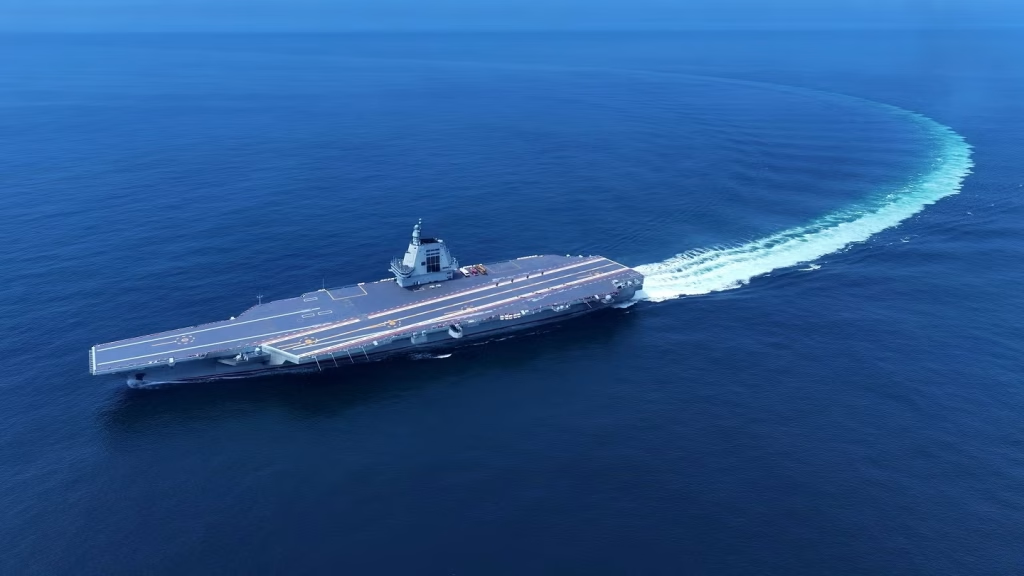
For every 8 warships Beijing builds and deploys, the US produces less than 2 highlighting its industrial leverage. In 2011, China was a nation without an aircraft carrier while US had a fleet of 10. Fast forward to 2025, US has 11 active aircraft carriers whereas Beijing has 3 with the latest marvel- the Fujian. Th Fujian is not only China’s most advanced carrier but also the world’s only non-US supercarrier equipped with Electromagnetic Aircraft Launch System (EMAL), a technology seen in America’s new generation Ford Class carrier. While Ford-class carriers can launch four jets simultaneously compared to Fujian’s three, this is the limitation of the propulsion system where US still leads. Beijing is working on closing the propulsion gap with America.
Supercarriers: Redefining Naval Balance
China Type 004 carrier fixes the propulsion problem. Wait, Type 004? Wasn’t Type 003 (Fujian) commissioned this year? So, the Chinese are already onto the new carrier. This rapid pace of development is great, right? It’s not even half of it. One might think that Type 004 is of the same class as Fujian, after all Fujian is on par with US Ford-class carriers. Wrong. Even though, Fujian, 84000 tons is a supercarrier and on par with Ford-class (100000 tons), it is small and its propulsion is limited. Here comes the new behemoth, the Type 004 carrier.
Unlike its predecessors, Type 004 warship is not only on par with America’s carriers in terms of launch and propulsion systems but actually exceeds them in sheer tonnage. At 120,000 tons, the Type 004 dwarfs the U.S. Navy’s USS Gerald Ford, which stands at 100,000 tons. This leap signals China’s determination to match and surpass US naval supremacy. The symbolism is very clear. Beijing is not just catching-up – it is setting new benchmarks in carrier design. In little over a decade, it has gone from zero carriers to building supercarriers that not just rival but also outsize America’s most advanced fleet assets. By 2035, China aims to operate a fleet of six aircraft carriers, a force that would rival the U.S. Navy’s global strike capability.
Next Generation Air and Nuclear Power
It is also expected to field over a thousand 5th Gen J-20 Mighty Dragon jets. The prototypes for the 6th-generation jets, J-36 and J-50, were unveiled in December 2024. This comes at a time when major countries are still struggling with 5th-generation development, let alone advancing to 6th-generation aircraft. America’s own NGAD Program is nowhere close to prototype as it is still on paper. Beijing is expanding its nuclear arsenal at a pace unseen since the cold war. At the current pace, it could reach parity with the US by 2035 with over 1500 nuclear weapons. China is also scaling next-generation thorium-based reactors for civil nuclear power, positioning itself at the forefront of advanced nuclear energy technologies.
Conclusion
From clean energy and EV dominance, from AI patents to next gen military assets and nuclear power, Beijing’s rise is not just a projection but a reality. In just over a decade, China has transformed itself from a global follower to a designer and frontrunner, scaling industrial capacity, technological innovation and military assets at a pace unheard of in human history in peace time. While the US still leads in many sectors, the technological gap and barrier is rapidly decreasing in every frontier. The trillion-dollar trade surplus, next gen military assets illustrate a nation determined not just to catch up, but to define the benchmarks of global power.
The strategic question for the world is whether China can challenge US primacy. This is how nations will adapt to the multi-polar world where Beijing sets pace in critical domains. For the US, the message is clear: the days of unmatched supremacy are over. It’s time to set foot on the ground and move with unprecedented urgency if America wants to compete. Otherwise, as former President Joe Biden warned, “If we don’t get moving, they are going to eat our lunch” a prophecy that will prove true if the U.S. fails to step up its infrastructure and industrial base. China vs US: Dominance Across Every Frontier, is no longer a fantasy, but a reality.
The message to Washington is loud and clear. The race has just begun, and the momentum has shifted. Beijing is no longer chasing – it is leading. The race of China vs US: Dominance Across Every Frontier has shifted – Beijing is leading as an equal superpower.
Is China a superpower: click here to read
How is US a hegemon in decline: click here to read


Leave a Reply